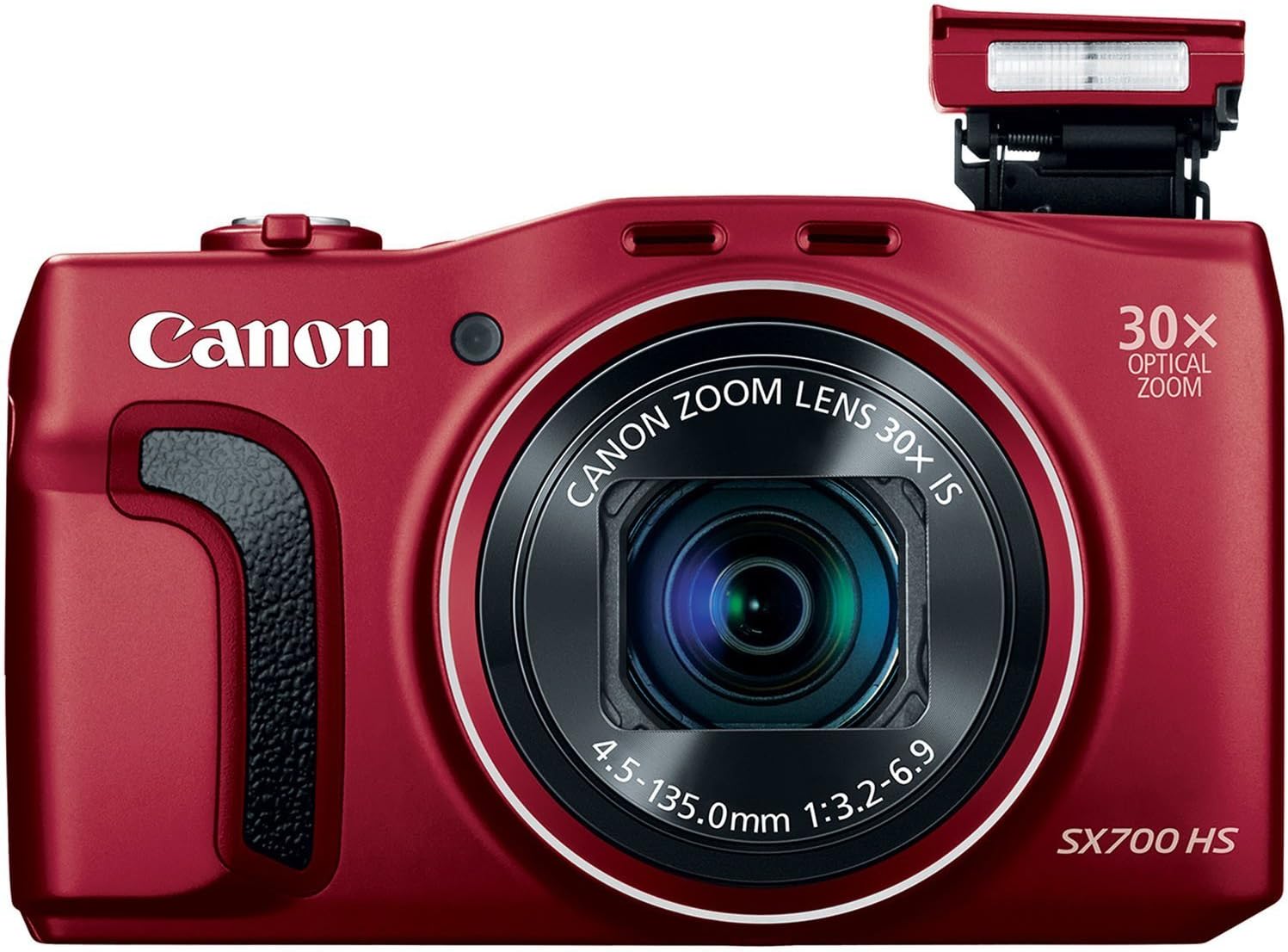
PowerShot SX700 HS (Red)
Product ID: 1163415
🎥1080p Full HD Video
📸16.1 MP Sensor
🔍30x Optical Zoom
📷 Snap, Share, Shine! Unleash your inner photographer with the Canon PowerShot SX700 HS.
The Canon PowerShot SX700 HS is a compact digital camera featuring a 16.1 Megapixel High-Sensitivity CMOS sensor and DIGIC 6 Image Processor for superior low-light performance. With a powerful 30x optical zoom and the ability to record 1080p Full HD video, this camera is designed for versatility and creativity. The Creative Shot mode adds an artistic touch to your photos, while the Mobile Device Connect Button allows for quick sharing with your smartphone.
P**M
Great Travel Zoom
For the recent few years Canon has made great efforts to improve their travel-zoom compact cameras, and the new SX700 is their next remarkable achievement on that way. It's a little bit bigger than its predecessor (SX280) but it is very well built and has an attractive look and feel (I like the black one). It also got a new front grip which makes one-hand shooting more convenient, even when shooting video, since the Video button was moved from the back to the top and you can now use your thumb solely for holding the camera.Here is a brief list of the new camera pros & cons:PROS:* A very good design and build quality with the attractive finish.* A new powerful 30x optical zoom lens in just a pocket-size body.* Incredible range from 25mm wide to 750mm telephoto for stills and video.* Zoom Framing Assist - very useful new feature to compose your pictures at long telephoto.* Very effective optical Intelligent Image Stabilization for stills.* 5-axis Dynamic Image Stabilization and continuous AF for movies.* New 16MP high-resolution, high-speed CMOS Sensor.* The recent DIGIC6 processor with a new advanced Noise Reduction algorithm.* Intelligent Contrast system to retain shadow detail in high contrast scenes.* Full HD 1920 x 1080, 60 fps progressinve movie recording in a popular MP4 format.* Good-quality stereo microphones facing the subject being recorded.* A dedicated Movie-button for instant recording, now on the top of the camera.* A new high-resolution 922K, 3" display.* WiFi and NFC (Near Field Communication) features for transferring files to your smartphone or tablet.* Short startup time (just about 1 sec) and no any noticeable shutter Lag.* Almost the same battery (NB-6LH) as for SX280 (NB-6L) - old one works fine .CONS:* Slightly bigger and heavier than its predecessor SX280.* A new Noise Reduction algorithm is more aggressive on low-contrast areas.I'm basically a photo-amateur, but sometimes I do big prints and so my first priority is the image quality, and in particular its clarity at the pixel level. That's why my recent travel-zoom cameras consequently were SX230, SX260, and SX280, since Canon is doing all their best to preserve the fine details of the picture even at higher ISO's. With my recent SX280 I took many good pictures - sharp and clean, with nice colors, however while doing some research regarding the new SX700 camera features and characteristics I got a number of reasons for upgrade which I would like to share with you. Actually there are 3 main reasons: 30x Zoom Lens, 16-Megapixel CMOS sensor, and the advanced DIGIC 6 processor with the new Noise Reduction Algorithm.LENS: A new powerful 30x optical zoom lens with an Optical Image Stabilization, which spans an incredible 25-750mm equivalent range in a pocket-sized body, is a significant improvement over the SX280's 20x range. The real achievement is that the aperture of the new lens at its maximum 30x telephoto end drops to almost the same (F/6.9) value as of its predecessor at only 20x (F/6.8), what means the additional zoom will not cost you the increased ISO and therefore will not bring more noise to your pictures.On the other hand, when wide-open, the new lens provides slightly better aperture - F/3.2 than the older one - F/3.5, what gives you some advantage for shooting in low light conditions. The new SX700 also introduces an interesting feature - Zoom Framing Assist, which should help with composing shots of far distant subjects. I have to play with it for a while to find out how it actually works.SENSOR: The newly designed 1/2.3" CMOS sensor can produce 16 Megapixel images while having actually 17 MP - it seems extra pixels are needed to provide additional digital image stabilization along with the existing optical one, what would be very helpful for shooting with such a long zoom. From the prospective of the image resolution, it is nice to step up from the prior 12 MP to the new 16 MP especially for landscape photos, what allows to present more fine details and to make your pictures to look more natural than before. Of course, packing more megapixels into the same sensor size causes less light to be collected by each pixel, but on the other hand, Canon stated this new one is a "High-Sensitivity CMOS sensor" and also a new noise-reduction algorithm works more effectively, so such a resolution leap should not cause any noticeable deterioration in IQ.I'm really thankful to Canon especially for the two design decisions: for years they were not following that crazy mega-pixels race; and they were not afraid to generate large (up to 10MB) jpeg files in "Large" mode to preserve as much fine details as possible. Having got such detailed jpeg files you can have much less regret of not having the RAW output, than if your camera always packed your pictures into just 2-3 MB with a lot of smearing and smudging in low contrast areas. On the other hand if you don't need so detailed pictures you can always select either "Medium" or "Small" file size.NOISE REDUCTION: The Canon SX700 uses the recent Canon's DIGIC 6 processor, which was first introduced in the SX280 model and provided the improved noise reduction technique especially at higher ISO's. It's a kind of luxury for such a small camera to have such an advanced processor, and at the moment of writing this review only a few enthusiast's Canon cameras like G1X II, G16, S120 was equipped with that powerful picture processing engine.Although both cameras SX280 and SX700 use the same processor, the latest model has more advanced Noise Reduction Algorithm which provides more smooth rendering of the low-contrast areas with significantly less visible noise. People say one picture is worth a thousand words, but the Amazon rules do not allow to include external links to pictures in the text of the review itself, however they do not mind them in the comments. So I put those links with the respective explanations into my own comments and so you can treat them as a part of this review. Actually you will find there the links to the two 100%-crop fragments of green leaves taken by the old and new camera respectively. While the most bright areas on both fragments look pretty much the same, the areas with less light on the older camera's shots show the noticeable noise, while the SX700's counterparts look almost clear, however a bit softer.LOW_LIGHT: Both cameras have pretty similar and one of best on the market High Sensitivity (HS) system for taking pictures in low-light conditions with minimal noise. In many cases if you shoot even at the highest ISO and then browse those pictures on you monitor without additional cropping, you hardly can see any noise at all (since even Full HD monitors have resolution just about 2MP, and the most advanced - not more than 3-4MP). So from that prospective the difference between two cameras is not that big: the new SX700 provides slightly less visible noise (if any at all) but at the price of somewhat softer images, however all those imperfections of both cameras for most of the ISO range from 100 to about 800 in reality are visible only on the really big prints, and only above ISO-800 the smearing of the fine details becomes visible. So both cameras can be considered as good players in the low-light league. I took the 2 series of shots at high ISO with both cameras, and for the viewers convenience I put them as the 2nd part into my most first comment for this review.SHARPNESS: The sharpness of the output jpeg pictures pretty much depends on the "Compression" settings: to get the maximum details you have to select the "Super Fine" mode, which will produce the jpeg files with the size up to 10MB. If you don't need big prints you can choose "Fine" compression which will result in jpeg files about 5MB or less for the full 16MP resolution. Be aware that with the "Fine" setting the pictures at 100%-crop will look significantly softer at any ISO, however if you browse them on your monitor in the full-screen mode they will look almost the same. Also if you're only going to upload them on Internet or make small prints, you can even choose instead of "Large" resolution the "Medium" one (actually there two of them - "M1" with 8MP and "M2" with 3MP) what will produce even smaller files and will give you more room on your flash memory card and hard disk.So I took some comparative test shots with my both cameras SX280 and SX700 at the ISO-100, max resolution, and the Super-Fine compression in the range of the equivalent focal lengths from 25mm to 500mm. Since the both cameras have a pretty good noise reduction mechanisms, the noise is not visible on all those shots, and the only difference is in the effective sharpness, which can vary in the zoom range. I put the links to those shots into my comment on 04/10/14 with the respective explanations.SAMPLE_PICTURES: I've uploaded some real-world pictures and you can get links to them in my comment with the respective title posted on 04/13/2014.VIDEO: As the same as its predecessor, this camera can capture stunning 1080p 60p/30p Full HD video using a dedicated movie button which now resides on the top of the camera. And to provide sharp results the new SX700 is equipped with an Intelligent Image Stabilization system plus 5-axis Dynamic IS for steady movies.VIDEO_SAMPLES: I've uploaded some video clips and you can get links to them in my comment with the respective title posted on 04/11/2014.So this new Canon camera is a very good compact device for taking nice still pictures and advanced video recording.
K**N
It was shipped via USPS and that was fine except the shipper selected a required signature upon receipt
I bought this to take with me on day hikes and weekend backpacking trips. It was shipped via USPS and that was fine except the shipper selected a required signature upon receipt. That would have been OK but I was at work when it arrived, so USPS sent me a failed delivery notice and I had to pick it up at the post office on my lunch hour the next day, so that was inconvenient for me. If you order this online, pay attention to how they'll ship it to you. Seems obvious in retrospect so my bad. The camera arrived, packed well, and was in new condition when I received it.Caveats to this review: I primarily used the camera in auto mode. I didn't read the instruction manual. I did read a lot of online reviews and I did purchase an extra battery and a car charger for the batteries-which is a must. I did purchase a padded camera bag to carry it with. The camera bag was lightly padded, canvas cloth and I water-proofed it somewhat with silicone spray. The accessories added to the overall cost but in my opinion are required. I also bought a 32 gig memory card which is also required. The 32 gig card was just right for me. I used 2 batteries a day and took approx. 500 plus pictures per day with no issues. I had three batteries total with me but only needed two.The camera exceeded my expectations. I was hoping for something better than my cell phone camera. A lot of cell phone cameras these days come in 16 Megapixel and the iPhone in particular takes amazing photos. Where this dedicated camera beats them is in the zoom. The zoom was excellent and will take a great picture at distance if you give it time to find the focus. The camera was light and convenient to carry with the camera bag and strap. I was able to access it quickly for wildlife photos. The zoom helped enormously with this as I could take shots at distance and not spook the wild things. If I had to spend the money again I would consider a camera with 20 megapixel or greater capability but I was happy overall with the pictures this camera produced in my newbie hands. One final note is that this camera does not have a panorama mode. I didn't think I needed this for my intended use. However as you will see in the pics below I took at Arches national park in Moab, Utah, I missed an incredible shot that a panorama mode would have nailed. If you want a good travel camera this one is pretty decent but I would look for a higher megapixel count and a panorama mode for the same money and take a chance on it if I had to do it over provided I could find one with this zoom capability and shake cancellation. Other reviews said this camera isn't so great at night shots and I agree. It isn't at least not in auto mode. But it did great at sunrise in Moab I felt. Good luck!
J**O
Bon achat
L'appareil a été livré rapidement et tel que décrit. Il est arrivé avec l'étui de transport, batterie, chargeur de batterie et le tout en excellente état.
R**O
Good quality
received as expected
T**E
Great pictures from this camera
Great pictures from this camera. The only problem was the camera user guide that came with it, the writing and pictures were to small . I downloaded this user guide from the internet and the writing and pictures are very easy to see and understand.
C**Y
Five Stars
Bon service, très belle caméra facile à utiliser
D**Y
wifi operation
seems to be a very good camera....just received it....
Trustpilot
5 days ago
3 weeks ago