We remain fully operational. Our teams are working around the clock to ensure your deliveries continue safely.

DOWNLOAD THE APP


Copyright © 2025 Desertcart Holdings Limited
DOWNLOAD THE APP
Buy anything from 5,000+ international stores. One checkout price. No surprise fees. Join 2M+ shoppers on Desertcart.
Desertcart purchases this item on your behalf and handles shipping, customs, and support to Bermuda.
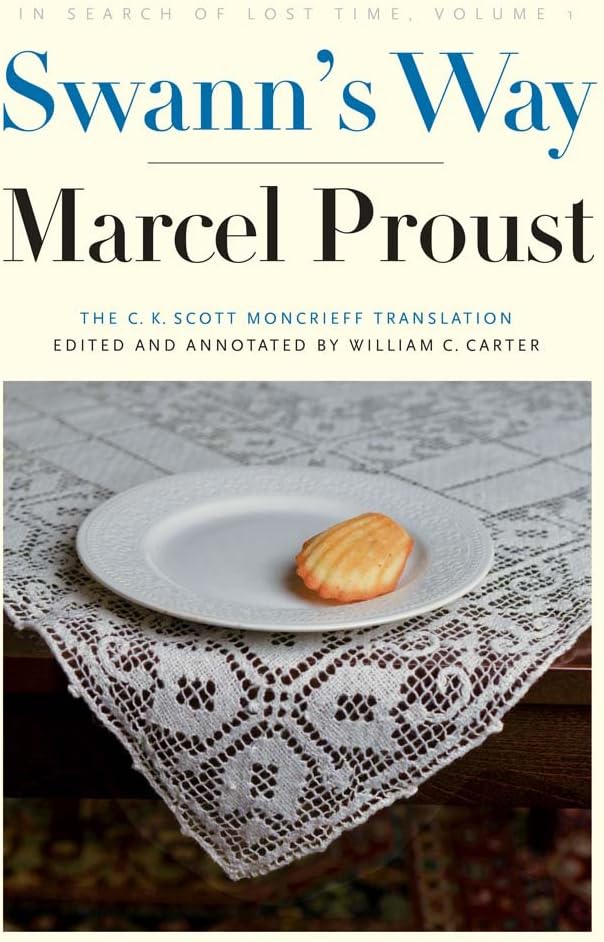
Swann's Way: In Search of Lost Time, Volume 1 [Proust, Marcel, Carter, William C.] on desertcart.com. *FREE* shipping on qualifying offers. Swann's Way: In Search of Lost Time, Volume 1 Review: Worthy of its status as one of the great works of literature - Latest English translation from French, 2002. 444 pages. Book 1 of À la recherche du temps perdu [In Search of Lost Time, in seven volumes] UPDATED: 11/21/2018 Summarizing Proust has a long history, most hilariously shown in the Monty Python sketch “Summarizing Proust Competition” in which contestants attempt to summarize all seven volumes of ‘In Search of Lost Time’ within 15 seconds: Having just finished SWANN’S WAY, my summary takes this condensed haiku form: Madeleine in tea Brings memories of lost time Marcel is left sad Now for something completely different. SWANN'S WAY, the first of Proust's seven-volume novel, is a joy to read. For a novel about which many detractors have said 'Nothing happens' it was engaging, imaginative, full of philosophical ideas, and, as the saying goes, was hard to put down. Is it a series of Proust's philosophical musings disguised as a novel? Or the inverse? An autobiography disguised as a novel? All the above? Call it what you will, but boring and uninteresting? Quite the opposite. Summing up SWANN'S WAY properly, I would say: The unnamed narrator of undefined age (though clearly old enough to reflect back on his childhood) – call him Marcel – is facing a very real and common human affliction, particularly of those of us of later age, a world-weariness, a discontent, dissatisfaction for the way life has turned out. Why is the world the way it is? At the opening of the novel, Marcel is seeking solace from this melancholy in recollections of a time past, a better time in Combray with his parents, but the memories are mere shadows – “Dead forever? Possibly.” [44] Then, unbidden, come a flood of Combray memories, triggered by the taste of a piece of madeleine dipped in tea, connecting present and past experiences, transcending time and space: And suddenly the memory appeared. That taste was the taste of the little piece of madeleine which on Sunday mornings at Combray (because that day I did not go out before it was time for Mass), when I went to say good morning to her in her bedroom, my aunt Leonie would give me after dipping it in her infusion of tea or lime blossom.... immediately the old gray house on the street, where her bedroom was, came like a stage set to attach itself to the little wing opening onto the garden that had been built for my parents behind it....and the water lilies of the Vivonne, and the good people of the village and their little dwellings and the church and all of Combray and its surroundings, all of this which is acquiring form and solidity, emerged, town and gardens alike, from my cup of tea. [p 47-48] And so begins Marcel's remembrances, or, more to Proust's intent, Marcel's 'search for lost time,' (or, playing on the translation of temps perdu, which adds yet another reading to the novel, 'wasted time'.) The novel weaves in and out of time, as memories do, forever timeless, stream-of-consciousness style, Marcel bringing to vivid mind people, places, and events from his past life, involuntary recalls sparked by the sensory stimulus of a phrase from a violin sonata, the fragrance of a lily, the taste of a madeleine. The themes of art, memory, time, identity, family, love, friendships, and beauty run throughout SWANN'S WAY. One concept that seems crucial to the narrator's metaphysics I found particularly interesting – that one can only really glimpse reality, the actual 'thing itself', through art – painting, music, literature. It is through art that we get a sense of the beauty of the world, a beauty which our meager fleeting senses cannot grasp. It posits that there is something more real hidden beneath the veneer of the physical world which we can only discover through artistic endeavor. It is art which captures that ineffable, transcendent something we sense but cannot grasp. One of my favorite passages in SWANN'S WAY which illustrates this is the narrator's description of seeing the twin steeples of Martinville church and the steeple of Vieuxvicq while riding the winding streets in an open carriage: As I observed, as I noted the shape of their spires, the shifting of their lines, the sunlight on their surfaces, I felt that I was not reaching the full depth of my impression, that something was behind that motion, that brightness, something which they seemed at once to contain and conceal. [184] A long paragraph follows in which Marcel cranes his neck this way and that to keep the steeples in view as the carriage makes its way through the narrow streets, until finally: Soon their lines and their sunlit surfaces split apart, as if they were a sort of bark, a little of what was hidden from me inside them appeared to me, I had a thought which had not existed a moment before, which took shape in words in my head, and the pleasure I had just recently experienced at the sight of them was so increased by this that, seized by a sort of drunkenness, I could no longer think of anything else.... Without sayint to myself that what was hidden behind the steeples of Martinville had to be something analogous to a pretty sentence, since it had appeared to me in the form of words that gave me pleasure... [185] Marcel goes on to commit his observations to paper, and only discovers the ineffable quality of those steeples once he has committed them to language, to words, to literature. But by the end of the book, Marcel laments that he is not suited for the time in which he now lives, this shabby, vulgar, inelegant time. Rather than buoy his spirits, his memories of a better, more elegant and sophisticated time merely depress. “The reality I had known no longer existed... The places we have known do not belong solely to the world of space in which we situate them for our greater convenience. They were only a thin slice among contiguous impressions which formed our life at that time; the memory of a certain image is but regret for a certain moment; and houses, roads, avenues are as fleeting, alas, as the years.” [444] There is so much more to this book, of which I have discussed just a sampling of the themes in this seven-volume, 4,200-page novel. I look forward to this great adventure in literature. Review: Incredible prose, but not sure it is for a general modern audience - Every year I try to hit at least one to two giant, heavy classics. I began 2016 right away with Swann's Way, book one of In Search of Lost Time, and it took me a little under a month to read it. Interestingly, the reason it took me a month wasn't so much that it was a difficult book to get through in terms of prose, but it was a difficult book to get through in terms of content for me. I loved the writing in this book. In many ways it reminded me of a Knausgaard of the time – a fictionalized memory prose-poem about life. It is gorgeous, verdant, and thick with imagery and language. But the thing I can't get over is, this goes on for six more volumes? And yet everyone from Bloom to Nabokov praise it. I get it – it is beautifully written – but I think my antennae were up as a writer not a reader. The problem I had with it in many ways was this, as a matter of fact. In many ways I wondered, would this book be published today? The book is so thick with romanticized language and events – which does contain gorgeous turns of phrase, images, interactions, and moments – that it takes away from the narrative pace. So much so that barely anything actually happens besides Marcel's deep analysis of every minor thing. It became so tedious to me at about the halfway point that I felt sick wading through the words. That said, I got a complete picture of the characters in the book, and their three-dimensionality was almost shockingly astute... But it takes six hundred pages to make this happen. That said, the story of Swann and Odette was very close to me, and in many ways I understood his frustrations and difficulties in his relationship with her. I enjoyed reading this most of the time, but more of as a writer and literary academic than as a reader. I will likely not follow through by reading the remainder of the series, but I am happy that I read this one as difficult as it was this time through. Last note, I actually thought was a part of my 100 books every man should read list, as well as my modern library top 100 list. Upon looking at the lists again, it is on neither (but maybe should have been on the Man list?), so I feel a bit confused as to how I managed to make it to this. Regardless, I am happy I have read it, but perhaps I will only revisit it in portions from here out.
| Best Sellers Rank | #925,161 in Books ( See Top 100 in Books ) #633 in Classic Literature & Fiction #1,018 in Biographical & Autofiction #1,503 in Literary Fiction (Books) |
| Customer Reviews | 4.3 4.3 out of 5 stars (2,453) |
| Dimensions | 7.5 x 1.06 x 9.25 inches |
| Edition | Volume 1 |
| ISBN-10 | 030018543X |
| ISBN-13 | 978-0300185430 |
| Item Weight | 1.92 pounds |
| Language | English |
| Print length | 512 pages |
| Publication date | November 14, 2013 |
| Publisher | Yale University Press |
M**N
Worthy of its status as one of the great works of literature
Latest English translation from French, 2002. 444 pages. Book 1 of À la recherche du temps perdu [In Search of Lost Time, in seven volumes] UPDATED: 11/21/2018 Summarizing Proust has a long history, most hilariously shown in the Monty Python sketch “Summarizing Proust Competition” in which contestants attempt to summarize all seven volumes of ‘In Search of Lost Time’ within 15 seconds: Having just finished SWANN’S WAY, my summary takes this condensed haiku form: Madeleine in tea Brings memories of lost time Marcel is left sad Now for something completely different. SWANN'S WAY, the first of Proust's seven-volume novel, is a joy to read. For a novel about which many detractors have said 'Nothing happens' it was engaging, imaginative, full of philosophical ideas, and, as the saying goes, was hard to put down. Is it a series of Proust's philosophical musings disguised as a novel? Or the inverse? An autobiography disguised as a novel? All the above? Call it what you will, but boring and uninteresting? Quite the opposite. Summing up SWANN'S WAY properly, I would say: The unnamed narrator of undefined age (though clearly old enough to reflect back on his childhood) – call him Marcel – is facing a very real and common human affliction, particularly of those of us of later age, a world-weariness, a discontent, dissatisfaction for the way life has turned out. Why is the world the way it is? At the opening of the novel, Marcel is seeking solace from this melancholy in recollections of a time past, a better time in Combray with his parents, but the memories are mere shadows – “Dead forever? Possibly.” [44] Then, unbidden, come a flood of Combray memories, triggered by the taste of a piece of madeleine dipped in tea, connecting present and past experiences, transcending time and space: And suddenly the memory appeared. That taste was the taste of the little piece of madeleine which on Sunday mornings at Combray (because that day I did not go out before it was time for Mass), when I went to say good morning to her in her bedroom, my aunt Leonie would give me after dipping it in her infusion of tea or lime blossom.... immediately the old gray house on the street, where her bedroom was, came like a stage set to attach itself to the little wing opening onto the garden that had been built for my parents behind it....and the water lilies of the Vivonne, and the good people of the village and their little dwellings and the church and all of Combray and its surroundings, all of this which is acquiring form and solidity, emerged, town and gardens alike, from my cup of tea. [p 47-48] And so begins Marcel's remembrances, or, more to Proust's intent, Marcel's 'search for lost time,' (or, playing on the translation of temps perdu, which adds yet another reading to the novel, 'wasted time'.) The novel weaves in and out of time, as memories do, forever timeless, stream-of-consciousness style, Marcel bringing to vivid mind people, places, and events from his past life, involuntary recalls sparked by the sensory stimulus of a phrase from a violin sonata, the fragrance of a lily, the taste of a madeleine. The themes of art, memory, time, identity, family, love, friendships, and beauty run throughout SWANN'S WAY. One concept that seems crucial to the narrator's metaphysics I found particularly interesting – that one can only really glimpse reality, the actual 'thing itself', through art – painting, music, literature. It is through art that we get a sense of the beauty of the world, a beauty which our meager fleeting senses cannot grasp. It posits that there is something more real hidden beneath the veneer of the physical world which we can only discover through artistic endeavor. It is art which captures that ineffable, transcendent something we sense but cannot grasp. One of my favorite passages in SWANN'S WAY which illustrates this is the narrator's description of seeing the twin steeples of Martinville church and the steeple of Vieuxvicq while riding the winding streets in an open carriage: As I observed, as I noted the shape of their spires, the shifting of their lines, the sunlight on their surfaces, I felt that I was not reaching the full depth of my impression, that something was behind that motion, that brightness, something which they seemed at once to contain and conceal. [184] A long paragraph follows in which Marcel cranes his neck this way and that to keep the steeples in view as the carriage makes its way through the narrow streets, until finally: Soon their lines and their sunlit surfaces split apart, as if they were a sort of bark, a little of what was hidden from me inside them appeared to me, I had a thought which had not existed a moment before, which took shape in words in my head, and the pleasure I had just recently experienced at the sight of them was so increased by this that, seized by a sort of drunkenness, I could no longer think of anything else.... Without sayint to myself that what was hidden behind the steeples of Martinville had to be something analogous to a pretty sentence, since it had appeared to me in the form of words that gave me pleasure... [185] Marcel goes on to commit his observations to paper, and only discovers the ineffable quality of those steeples once he has committed them to language, to words, to literature. But by the end of the book, Marcel laments that he is not suited for the time in which he now lives, this shabby, vulgar, inelegant time. Rather than buoy his spirits, his memories of a better, more elegant and sophisticated time merely depress. “The reality I had known no longer existed... The places we have known do not belong solely to the world of space in which we situate them for our greater convenience. They were only a thin slice among contiguous impressions which formed our life at that time; the memory of a certain image is but regret for a certain moment; and houses, roads, avenues are as fleeting, alas, as the years.” [444] There is so much more to this book, of which I have discussed just a sampling of the themes in this seven-volume, 4,200-page novel. I look forward to this great adventure in literature.
G**R
Incredible prose, but not sure it is for a general modern audience
Every year I try to hit at least one to two giant, heavy classics. I began 2016 right away with Swann's Way, book one of In Search of Lost Time, and it took me a little under a month to read it. Interestingly, the reason it took me a month wasn't so much that it was a difficult book to get through in terms of prose, but it was a difficult book to get through in terms of content for me. I loved the writing in this book. In many ways it reminded me of a Knausgaard of the time – a fictionalized memory prose-poem about life. It is gorgeous, verdant, and thick with imagery and language. But the thing I can't get over is, this goes on for six more volumes? And yet everyone from Bloom to Nabokov praise it. I get it – it is beautifully written – but I think my antennae were up as a writer not a reader. The problem I had with it in many ways was this, as a matter of fact. In many ways I wondered, would this book be published today? The book is so thick with romanticized language and events – which does contain gorgeous turns of phrase, images, interactions, and moments – that it takes away from the narrative pace. So much so that barely anything actually happens besides Marcel's deep analysis of every minor thing. It became so tedious to me at about the halfway point that I felt sick wading through the words. That said, I got a complete picture of the characters in the book, and their three-dimensionality was almost shockingly astute... But it takes six hundred pages to make this happen. That said, the story of Swann and Odette was very close to me, and in many ways I understood his frustrations and difficulties in his relationship with her. I enjoyed reading this most of the time, but more of as a writer and literary academic than as a reader. I will likely not follow through by reading the remainder of the series, but I am happy that I read this one as difficult as it was this time through. Last note, I actually thought was a part of my 100 books every man should read list, as well as my modern library top 100 list. Upon looking at the lists again, it is on neither (but maybe should have been on the Man list?), so I feel a bit confused as to how I managed to make it to this. Regardless, I am happy I have read it, but perhaps I will only revisit it in portions from here out.
J**N
There are three qualities to comment upon: the complete novel, the translation, and the kindle specifics. I'm going to post this review for all six volumes of the Prendergast series. If you've read it elsewhere, I apologise. I'd guess that my most helpful remarks will be about the kindle implementation. I'll cover all six books of this Prendergast edition. There is nothing in the general formatting to deter purchase of the kindle version. The complete novel is so large and there are so many characters that X-Ray would have been good. This series doesn't have it. But each volume does have a synopsis at the end which lists the elements of the narrative (for example “Swann's first meeting with Odette”; “Odette's vulgarity”), together with the page number. At the time of writing (June 2015), the usefulness of this feature varies from volume to volume. Its value is greatest in “In the shadow of young girls”, “The Guermantes Way”, and “The Prisoner and the Fugitive”. In all three the page number is a link, enabling one to jump directly to the page referenced. If, like me, you want to re-read passages, this feature is excellent. In “The Way by Swann's” and “Finding time again” the page numbers don't link directly to the referenced passages: you have to Go To the page number. Finally “Sodom and Gomorrah” doesn't contain page numbers, so those quoted in the Synopsis are almost useless. I assume that this is a production error, and I've informed Amazon. I've read that the Kilmartin/Enright edition has an index of place names and proper names and a thematic index, but I've no idea how well these are implemented on the kindle. I enjoyed the novel, but it has its weaknesses: the long sentences are quite often hard to comprehend without re-reading, and some passages are over-long. So I wouldn't expect everyone to enjoy it. You just have to try it. I opted to spend about £30 on the Predergast series, after starting the free (for kindle) Scott Moncrieff edition. I could have lived with the Scott Moncrieff but I just preferred a more modern text. I'm not able to compare the Prendergast series translations with Kilmartin and Enright's. Occasionally I wanted to compare the translation with Proust's French. This was hampered by the Prendergast series being based on the 1987 Pléiade edition, which is not in the public domain and so too expensive for me. There's an informative “General Editor's Preface” at the beginning of “The Way by Swann's”. I'd expect it would be included within the free sample available for kindle.
A**R
I personally don't like this book, but I can tell it is a good edition for studying the novel
S**A
I'll start off with the quality of the book - • The cover is absolutely gorgeous. • The pages are delicate (not as sturdy as other publications but still good) and have a premium feel. I seem to love it. • The font is small but still readable and it's appealing to the eye. • Absolutely no damages of any kind. • No bookmark received. • You can see the size of the book compared to a regular notebook. Now, about the Novel - Swann's Way by Marcel Proust is the 1st Volume of the book 'In Search of Lost Time' which consists of a total of 7 Volumes (a total of around 4000 pages). Swann's Way is one of the Greatest Novels of the 20th century to be ever written. The way the book is written is absolutely gorgeous, beautiful, poetic, magnificent, glorious, splendid, spectacular................................................................ Still, it's not a book for everyone, The book is a Remembrance of Things Past and Proust's narrative can sometimes be complex. The first 50pgs of the book deals with the topic Sleep, and the next 200 about the narrater's town, only then does the real plot begin, Swann's Jealous Love. Nonetheless, Proust's prose is breathtaking and is a must-read for every book lover out there. Hope this was helpful.
M**H
Decided it was time to reacquaint myself with some classics Print quality is good Found my self drifting off though not a one sitting read !!
K**R
Clássico de literatura!! Este livro como um dos grandes clássicos da literatura influenciou gerações de escritores e leitores, de modo que se tornou atemporal. Vale a pena dua leitura. Super recomendo.
Trustpilot
4 days ago
3 weeks ago