
DOWNLOAD THE APP


Customer Services
Copyright © 2025 Desertcart Holdings Limited
DOWNLOAD THE APP

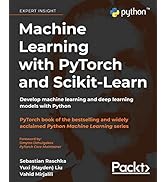
Buy Machine Learning with PyTorch and Scikit-Learn: Develop machine learning and deep learning models with Python by Sebastian Raschka, Yuxi (Hayden) Liu, Vahid Mirjalili (ISBN: 9781801819312) from desertcart's Book Store. Everyday low prices and free delivery on eligible orders. Review: This book could make PyTorch mainstream - I have used Sebastian Raschka's books in my teaching at the University Of Oxford before As usual, this book is excellent in its technical detail and thoroughness. However, it could also help to make PyTorch more mainstream. PyTorch has been gaining traction, but still mostly in the academic / research community. PyTorch has some excellent libraries (such as fast.ai) but still the world of PyTorch is a bit away from traditional Python for ML But by taking an approach of Scikit-Learn and PyTorch, this book could introduce PyTorch to a larger/mainstream audience of SKLearn users using a familiar paradigm. On first impressions, technically, the book is very much an enhancement of the previous book from Sebastian also (ex now includes transformers and GANs). Finally, I am also interested in PyTorch from the perspective of the metaverse. So, all in all an excellent - must read book - another great reference book from the author Review: The right level of detail - Very up-to-date - By no means an absolute beginner book. It strikes the correct balance: all the details to grasp the main concept, and a lot of pointers to more detailed explanations (often the very papers introducing the technology). In my case, as an experienced developer, with ML in my university curriculum (from two decades ago) a real trove of material. Most recent technology as transformers (e.g. GPT) are covered, as are the best python libraries from PyTorch to huggingface. The correct amount of code, enough to understand the concept, is found in the book. And the code I tried always worked correctly. A must have book!



| Best Sellers Rank | 225,520 in Books ( See Top 100 in Books ) 206 in Higher Mathematical Education 217 in Computer Information Systems 1,180 in Computing & Internet Programming |
| Customer reviews | 4.6 4.6 out of 5 stars (469) |
| Dimensions | 19.05 x 4.45 x 23.5 cm |
| ISBN-10 | 1801819319 |
| ISBN-13 | 978-1801819312 |
| Item weight | 1.41 kg |
| Language | English |
| Print length | 770 pages |
| Publication date | 25 Feb. 2022 |
| Publisher | Packt Publishing |
A**R
This book could make PyTorch mainstream
I have used Sebastian Raschka's books in my teaching at the University Of Oxford before As usual, this book is excellent in its technical detail and thoroughness. However, it could also help to make PyTorch more mainstream. PyTorch has been gaining traction, but still mostly in the academic / research community. PyTorch has some excellent libraries (such as fast.ai) but still the world of PyTorch is a bit away from traditional Python for ML But by taking an approach of Scikit-Learn and PyTorch, this book could introduce PyTorch to a larger/mainstream audience of SKLearn users using a familiar paradigm. On first impressions, technically, the book is very much an enhancement of the previous book from Sebastian also (ex now includes transformers and GANs). Finally, I am also interested in PyTorch from the perspective of the metaverse. So, all in all an excellent - must read book - another great reference book from the author
K**R
The right level of detail - Very up-to-date
By no means an absolute beginner book. It strikes the correct balance: all the details to grasp the main concept, and a lot of pointers to more detailed explanations (often the very papers introducing the technology). In my case, as an experienced developer, with ML in my university curriculum (from two decades ago) a real trove of material. Most recent technology as transformers (e.g. GPT) are covered, as are the best python libraries from PyTorch to huggingface. The correct amount of code, enough to understand the concept, is found in the book. And the code I tried always worked correctly. A must have book!
D**T
In-depth book covering numerous topics. Highly recommended.
This book is a comprehensive, wide-ranging detailed, book that covers a huge range of different topic areas in great detail. Make no mistake this book is big - 700+ pages of in-depth content, and much, nay, most of it not aimed at the casual beginner. Across 19 chapters the authors go through topic such as building good training sets, dimension reduction techniques, best practices, ensembles, PyTorch, Scikit-Learn, CNNs, RNNs, transformers, GANs and much much much more. I, personally, have not read any other books by these authors, but I have bought and read many Packt books previously so I knew potentially what I would be getting. This book is so big and in-depth that there is no no way go through and digest, understand and remember everything in one go. And there is little point trying to remember everything anyway, it's much better to use the book as a reference book. As with other Packt books this book isn't just all about reading, there are plenty of coding samples that one can follow as progressing through the book. There is a handy summary at the end of chapter but no test yourself exercises, which may have been useful but would have made a big book even bigger. Giving my own interests I must make a special mention for chapter 16, the chapter on Transformers and NLP. The chapter is really well-written and explains the concepts of attention and how it is used in transformers, introduces Bert and also describes how to fine-tune it. All useful knowledge. In summary I have absolutely no hesitation in recommending this book. The authors have done a fantastic job and there is something for everyone in here. Highly recommended and a must buy.
E**D
A great advert for Pytorch
I always intended to buy the previous edition of this book but I had many books to work through at the time. So I’ve been waiting on the release of this book for quite a while. The book is quite an undertaking, from the introductory text of the how’s and why’s you are taken on a Lord Of The Rings scale of fantastic adventure through ML from the very basics to really quite nuanced depths. The early stages use many famous ML/Kaggle landmarks such as the Iris dataset, the breast cancer dataset, discussions on stochastic gradient descent, and an introduction to the Scikit-Learn tool belt. Next up is a deep dive into building good datasets and good coverage of many data engineering tasks with the aim of getting to a sweet spot where you can learn about the model evaluation and tuning, about combining different models for different evaluations. As you progress through the book you’ll jump to deeper levels and learn about building multi-layer neural networks from nothing, aiding your understanding of the various toolsets open to machine learning engineers and helping you be a skilled user rather than an engineer who utilizes black boxes of magic produced by other teams. This is ensured by following some set projects which is a nice touch for compounding the knowledge being presented to the reader. You will also cover GANs, Graph NNs, and reinforcement learning. There’s not much to criticize in this book other than the coverage is vast and wide. This means each subject could be, and is, the subject of many 400+ page books themselves. This book is like taking a whole ML course where you will learn an awful lot of stuff about a vast array of subjects, you may feel like there is no way to remember all this jargon and all this depth and you would be right - you could spend an awfully long time on this book trying to commit a lot of it to memory which would miss a lot of the point. The book acts like a map of ML you can take directions from it and go to these destinations to determine the depth you want to go to with each topic because each is an entire file of expertise. I would have no hesitation in recommending this book, I put an awful lot of hours into working through it and I could start again and learn just as much the second time around. If you are an ML enthusiast or a working ML engineer who is not working with PyTorch you stand to gain a lot from what is on offer here plus you have the bonus that PyTorch is rightly considered to be pythonic in its approach and syntax. A hugely enjoyable title if a little intimidating at the halfway stage. A fabulous achievement. A solid purchase.
Ö**R
Black & White Print!
The content is great but unfortunately the entire book has been printed in B&W, making it very difficult to interpret graphs and plots, which this book has quite a lot. Planning to return the item.
S**.
Poor print quality
Although paperback, the print quality compared to other paperbacks is not good and very disappointing given the tome of knowledge this book is. You will notice from the photo that the letters look like they've been chipped at.
L**I
Veryyyyyyyyy goood
I**K
everyone need this book i loved
D**S
The book is as described.
D**.
Es un excelente libro que nos permite aprender sobre ML y aplicarlo sin dejar de lado la teoría! Si lo lees completo, es como tomar un curso de ML bastante bueno, y estás listo para un rol de junior o más en el campo. Obvio, sin dejar de lado las bases matemáticas (que también las explica).
M**D
The only drawback is the use of toy datasets. The author should have added a one mega project that includes the concepts covered in the book. Yet great book that will make a difference to beginners
Trustpilot
1 week ago
2 days ago